We thank Kelvin Adams for bringing to our attention another war hero who is buried in the Brockley and Ladyell Cemeteries. He has kindly provided the following account.
Captain Walter Alfred Southey, legendary RFC and RAF fighter ace, was sometimes known as Peter Southey. He was awarded the D.F.C. plus bar. Originally 19th Royal Fusiliers. Regimental number, 6741. He enlisted in February 1916, joining the RFC on 5th August 1916. He flew Bristol Fighters with 48 Squadron and was wounded on 4th June 1917 and out of action till March 1918. He scored 20 victories with 84 squadron, between May and October 1918, flying the S.E.5a. His father was clearly stated to be a warehouseman in the lace trade, though this may be open to doubt - perhaps he was a manager. Walter is stated to have been born in Bermondsey, the family later living in Brockley and New Cross, with addresses in Arabin and Drakefell Roads. 
His early death from skull fracture was due to a motorcycle accident. I am indebted to his relative, Roger Goulder, for this information. Southey had been discharged from service, and his inscription reports that he was "late RAF". However The Air Ministry handled a claim from Drakefell Road in November 1920. His parent's names were Walter and Emma and they are buried with him. Walter Southey was one of the great pilots, taking on the enemy at a time when they had their finest planes and pilots and odds balanced heavily on their side. It is understood that Walter may have been a pupil at Christ's Hospital - the Bluecoat school - perhaps further suggesting that his father was more than a warehouseman.
Southey accounted for the following:
1 x Albatross D.V : 3 x Rumpler C
1 x Focker DR.1 : 8 x Focker D.VII
5 x Balloon : 2 x LVG.C
"A gallant and skilful officer"
"An officer of ready resource whose skilful leadership is of the greatest value to his squadron"
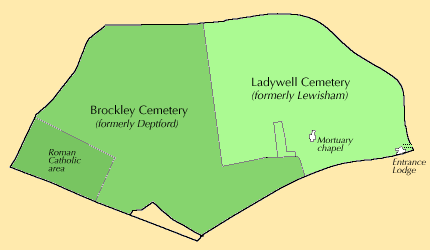
To find his memorial - start at the Ladywell entrance, pass the chapel (going under the arch), turn abrupt left and abrupt right. The Southey plot is 103J. It is in an edge section, facing south towards the well populated sections U,X and Y. I was suprised to find members of a supposed working family buried in such a prime position. The plot is just after the reddish-brown obelisk and the Cameron/Laxton plot.
Wednesday
The story of WW1 Ace Walter Southey
Posted by
Patrick Napier
at
18:57
Labels: First World War, Walter Southey, war graves
History and Notable Burials
Probably the most interesting (albeit gruesome) piece of history in Brockley Cemetery is a monument erected to the memory of Jane Clouson.
The monument was paid for by public money and stands alone amongst the trees - a praying child sits on top of a pillar.
Below the figure is an inscription detailing the horrific events surrounding her brutal murder on April 25th, 1871:
"A motherless girl who was murdered in Kidbrooke Lane Eltham age 17 in 1871. Her last words were, "Oh, let me die". "
The Scottish Times
News and intelligence from Scotland, and around the globe. Vol. II–No. 38.] Edinburgh, October 11, 1871. Price 3d.
[from Northstar Creative.co.uk]
GREENWICH MURDERER ACQUITTED. YESTERDAY, the Pook family of Greenwich, London, were forced to leave their family home, so strong was the feeling of the local community against them – the animosity having arisen from Mr E. Pooks recent acquittal at his trial, for the murder of Miss J. Clouson.
For anyone who has not been following the case, the public anger and resentment is quite understandable when one considers the undisputed evidence, in that: Jane Clouson was 17 year old when she gained employment at the Pook’s residence, that 3 years later Mr E. Pooks overcame her virtue, and that earlier this year the unfortunate girl found herself pregnant.
It was also revealed from testimonies that Miss J. Clouson had been led to believe Mr E. Pooks was going to make a respectable woman of her and, on the evening of her demise, she was going to meet him.
What follows next is a clear and exact series of events, which only a judge – with the mighty burden of the Law weighing down on his shoulders – could find circumstantial.
Sometime later on that fateful evening, a Constable discovered Jane Clouson in a wretched condition, crawling on Kidbrooke Lane with her head battered so severely, that one eye was hanging from its socket. She never fully regained consciousness, and died later in Guy’s Hospital.
Despite the facts that the accused was seen running from the lane, and that the murder weapon found at the scene – a hammer – had been sold to him by a local shopkeeper some days earlier, and that his trousers were covered in blood and mud : there still remained a “reasonable doubt”.
Mr Pooks claimed that he had spent the entire evening, awaiting with amorous intent, outside another ladies’ house in Greenwich – and this claim, much against everyone’s wishes, could not be disproved.
Notable burials:
Sir William Eames (1821-1897) Marine engineer
Sir John Gilbert (1817 - 1897) Illustrator, drawing for the 'Illustrated London News' and designed a cover for 'Punch'
Sir George Grove (1820 - 1900) First director of the Royal College of Music in 1882 - author of 'Dictionary of Music and Musicians)
Sir William Hardy (1807 - 1887) Deputy Keeper of Public Records 1878 - 1886
Sir Alexander Nisbet (1812 - 1892) Inspector General of the Royal Navy and honorary physician to the Queen
William Stephens (1817 - 1871) Grand Warden of the Grand Lodge of England
[information from London Cemeteries - Hugh Mellor]
Taken from London Necropolis


1 comments:
I see there's a small 'dividers and setsquare' symbol on the tableture. Does that suggest Freemasonry within the family? Do the Freemasons retain archives of 'their own' that could be accessed for further research?
Post a Comment