Lionel de Jersey Harvard was the only descendant of John Harvard (who gave his name in 1638 to the prestigious Ivy League University in the USA) ever to attend Harvard University. The direct descendant of John Harvard's brother, Thomas he entered the University in 1911 having gained a place with some assistance from Harvard president Lowell when he learned that Lionel was interested in attending. (NY Times entry)
Born in Lewisham on the 3rd June 1894 he attended St Olaves Grammar School and St Saviours School(Southwark) before entering the University after spending time working as an Insurance Broker. His arrival having sailed from Liverpool was well publicised and he appeared a popular student. Addressing the assembled graduates after his own graduation he stated that 'I have had four years here full to the brim of happiness'. Known as 'Johnny' to his contempories. he had planned to become a medical missionary on graduation. Two days after graduation he returned to England to enlist and in September 1915 he was gazetted to the Granadier Guards. He had attempted to enlist in 1914 but was unsuccessful. Having married Mary Barker shortly before he went into training in Chelsea with the First Battalion of the GG and went to Flanders in February 1916. The regiment was then occupying positions in the Ypres Salient, transferring to the Somme front where he received a bullet wound in the chest at Les Boeufs. Following his promotion to First Lieutenant in June, 1917, he rejoined his battalion in France.
In July he was back at Ypres and took part in the taking of Pilkem Ridge and other important engagements. In the Cambrai advance he saw heavy fighting at Fontaine Notre Dame, and later in stemming the enemy's onrush when the British line was pierced. At home he had now, besides his wife and his parents, a new born son Peter, With the great March Offensive in 1918 he was in the front line at Arras, having been commissioned as a Captain, when on the 30th March he was killed instantaneously by a shell explosion and was buried in the civilian cemetery at Boisleux-au-mont near to Arras. A superior Officer said of him after his death that he was 'One of the most conscientious and fearless Officers that I have ever known'. His only brother Lieutenant Kenneth O'Gorman Harvard' 2nb Batt GG (a second brother died in infancy) was killed by a sniper at Pilkem Ridge on the 1st August 1917 and is buried near Langemarck.
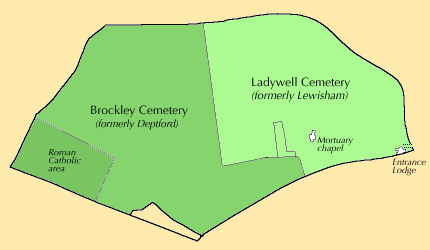
Lionel Hall is named after him at Harvard University and the annual Lionel de Jersey Harvard Fellowship was founded in his memory in 1928 which enabled students from Harvard to spend a year studying at Emmanuel College, Cambridge University (John Harvard alumnus). His easily located family grave lies a few yards from the Dissenters Chapel at the ladywell side of the cemetery.
Sunday
Lionel de Jersey Harvard: Brockley's Ivy League link
Posted by
Patrick Napier
at
23:26
Labels: First World War, Harvard, Lionel de Jersey Harvard
History and Notable Burials
Probably the most interesting (albeit gruesome) piece of history in Brockley Cemetery is a monument erected to the memory of Jane Clouson.
The monument was paid for by public money and stands alone amongst the trees - a praying child sits on top of a pillar.
Below the figure is an inscription detailing the horrific events surrounding her brutal murder on April 25th, 1871:
"A motherless girl who was murdered in Kidbrooke Lane Eltham age 17 in 1871. Her last words were, "Oh, let me die". "
The Scottish Times
News and intelligence from Scotland, and around the globe. Vol. II–No. 38.] Edinburgh, October 11, 1871. Price 3d.
[from Northstar Creative.co.uk]
GREENWICH MURDERER ACQUITTED. YESTERDAY, the Pook family of Greenwich, London, were forced to leave their family home, so strong was the feeling of the local community against them – the animosity having arisen from Mr E. Pooks recent acquittal at his trial, for the murder of Miss J. Clouson.
For anyone who has not been following the case, the public anger and resentment is quite understandable when one considers the undisputed evidence, in that: Jane Clouson was 17 year old when she gained employment at the Pook’s residence, that 3 years later Mr E. Pooks overcame her virtue, and that earlier this year the unfortunate girl found herself pregnant.
It was also revealed from testimonies that Miss J. Clouson had been led to believe Mr E. Pooks was going to make a respectable woman of her and, on the evening of her demise, she was going to meet him.
What follows next is a clear and exact series of events, which only a judge – with the mighty burden of the Law weighing down on his shoulders – could find circumstantial.
Sometime later on that fateful evening, a Constable discovered Jane Clouson in a wretched condition, crawling on Kidbrooke Lane with her head battered so severely, that one eye was hanging from its socket. She never fully regained consciousness, and died later in Guy’s Hospital.
Despite the facts that the accused was seen running from the lane, and that the murder weapon found at the scene – a hammer – had been sold to him by a local shopkeeper some days earlier, and that his trousers were covered in blood and mud : there still remained a “reasonable doubt”.
Mr Pooks claimed that he had spent the entire evening, awaiting with amorous intent, outside another ladies’ house in Greenwich – and this claim, much against everyone’s wishes, could not be disproved.
Notable burials:
Sir William Eames (1821-1897) Marine engineer
Sir John Gilbert (1817 - 1897) Illustrator, drawing for the 'Illustrated London News' and designed a cover for 'Punch'
Sir George Grove (1820 - 1900) First director of the Royal College of Music in 1882 - author of 'Dictionary of Music and Musicians)
Sir William Hardy (1807 - 1887) Deputy Keeper of Public Records 1878 - 1886
Sir Alexander Nisbet (1812 - 1892) Inspector General of the Royal Navy and honorary physician to the Queen
William Stephens (1817 - 1871) Grand Warden of the Grand Lodge of England
[information from London Cemeteries - Hugh Mellor]
Taken from London Necropolis


0 comments:
Post a Comment